
REVIEW · KILIMANJARO MARANGU ROUTE
Kilimanjaro-marangu Route 6 Days Itinerary
Kilimanjaro is a hike with a countdown. The Marangu Route gives you a clear rhythm, hut nights, and a classic finish at Uhuru Peak without weird schedule gymnastics. I also like that your package includes airport transfers and you start with a real pre-climb briefing and gear check. One thing to think about first: Marangu is popular and can feel busier at the huts, so you’ll want to be patient and focused on your pace.
In This Review
- Key Highlights If You Want the Quick Answer
- Kilimanjaro Marangu Route Basics, Moshi Pickup, and What You’re Paying For
- Day 1 at Kilimanjaro Mountain Resort: Briefing, Medical Coverage, and Getting Ready
- Day 2: Marangu Gate to Mandara Hut Through Tropical Rainforest
- Day 3: Mandara to Horombo Hut, Moorland Views, and an Altitude Check
- Day 4 Acclimatization at Horombo and Zebra Rocks on the Way Toward Mawenzi
- Day 5: The Saddle and the Lunar Desert to Kibo Hut at 4,700 m
- Day 6: Midnight Summit Push, Gillman’s Point, Sunrise at the Crater Rim, Uhuru Peak
- Day 7: Down Past Mandara Hut to Marangu Gate, Summit Certificate, and Dinner at the Resort
- Day 8: Farewell in Moshi and Included Transfer to JRO
- What Makes This Marangu Plan Feel Practical, Not Just Romantic
- The One Caution I’d Actually Plan For: Pickup Timing and Operator Consistency
- Best Months to Climb Kilimanjaro and Why Weather Matters More Than You Think
- Who This Trip Suits (and Who Should Rethink It)
- Should You Book This Kilimanjaro Marangu Route 6-Day Climb?
- FAQ
- Where does the Kilimanjaro Marangu climb start and end?
- What is the meeting time for the tour?
- What hiking days and elevations are included?
- Are meals and tickets included?
- Is this a private tour?
- Can I cancel, and what happens if weather prevents the climb?
Key Highlights If You Want the Quick Answer
- Kilimanjaro Mountain Resort start point on the lower slopes, with an evening briefing and equipment check.
- Guided hut-to-hut itinerary with set elevation steps, including acclimatization time at Horombo.
- Night summit push details: wake before midnight, steep scree, sunrise at the crater rim, then down for real.
- Scenery at predictable moments: tropical rainforest, moorland views toward Kibo and Mawenzi, then lunar-desert terrain on the Saddle.
- Comfort constraints to plan for: Kibo Hut has no running water, and weather affects the exact conditions.
Other ways up Kilimanjaro we reviewed
- Kilimanjaro climb by Lemosho Route (7-day)★ 5.0 · 651 reviews
- Kilimanjaro climb, Machame Route (7-day)★ 5.0 · 262 reviews
- Kilimanjaro Climbing Lemosho Route 8 Days.★ 5.0 · 186 reviews
- Climbing Kilimanjaro – Machame Route★ 5.0 · 170 reviews
Kilimanjaro Marangu Route Basics, Moshi Pickup, and What You’re Paying For
This trip is based in Moshi, Tanzania, and you begin and end at Kilimanjaro Mountain Resort in Marangu. The total time is listed as about 8 days, even though the hiking plan is often described as a “6-day route.” That extra time matters because it gives you time for arrival, a proper briefing, and a paced descent day.
The price is $1,950 per person. For Kilimanjaro, that lands in the “not cheap but not random” category, and the value is mostly in what you get bundled: private group setup, park entry included each day of walking, hut nights during the climb, and the airport transfers being part of the package. If you already know you want a structured guide-led experience, that bundle usually beats cobbling it together yourself.
Also note the tone the operator sets. They stress that the success rates with their guides are outstanding compared to overall climbers. Nobody can promise a summit, but having a team that takes altitude and pacing seriously is the kind of service that can make your plan feel safer.
One practical reality: Kilimanjaro is not a routine hike. You’ll be dealing with cold nights, long walking days, and the mental game of moving slow when you feel you should go faster. Your “moderate physical fitness” is a good starting point, but altitude is the real test here.
Day 1 at Kilimanjaro Mountain Resort: Briefing, Medical Coverage, and Getting Ready
You’ll stay at Kilimanjaro Mountain Resort at the start. It sits on the lower slopes, so it’s the right kind of base: close enough to settle in, but not so remote that your arrival day turns into a stressful ordeal.
On Day 1, you meet in the evening at 5:30 pm for a pre-climb briefing and equipment check. That briefing is more than paperwork. It is where you learn how the climb works day by day, how you handle cold and early mornings, and how your guide team expects you to move. They also confirm you have mandatory medical coverage and travel insurance. Don’t treat that as a formality. Kilimanjaro emergencies are expensive and complicated, and insurance that covers mountain trekking is not where you want to gamble.
Dinner and breakfast are included here, with overnight at the resort. If you’ve ever done a big hike, you know Day 1 comfort affects Day 2. You want sleep, not chaos.
Day 2: Marangu Gate to Mandara Hut Through Tropical Rainforest
Day 2 starts with the short move from your hotel in Marangu to the National Park gate for formalities. Then the real hiking begins: tropical rainforest. This is the day where you warm up gradually and let your legs figure out the rhythm.
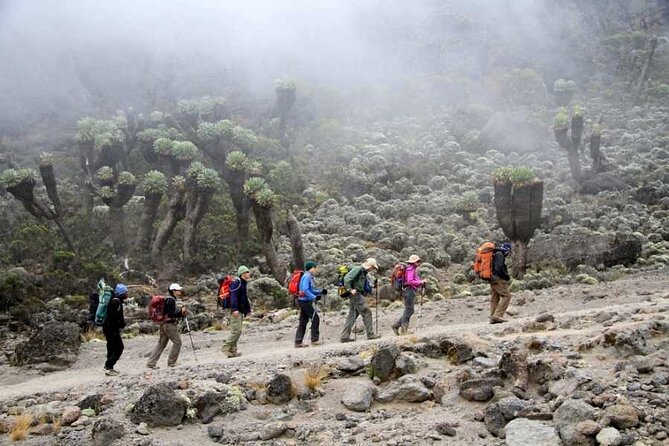
You walk from Marangu Gate (about 2,700 m) to Mandara Hut in roughly 5-6 hours. The path is described as “fascinating,” and that’s accurate in the Kilimanjaro way: constant living green, thick air, and the soundscape of birds and insects. The rainforest portion can be humid and slow going, so it’s less about speed and more about staying steady and not overeating early.
You reach Mandara mid-day for dinner and overnight at the hut. If you’re the type who gets anxious about sleeping in basic conditions, Mandara is a good “practice hut.” It sets expectations without throwing you straight into the cold, high altitude challenges.
Practical tip: rainforest days can make it feel like you’re not working that hard, but your body is still spending energy. Keep hydration in mind and avoid charging uphill just because the trail looks forgiving.
Marangu, other operators and other lengths
Day 3: Mandara to Horombo Hut, Moorland Views, and an Altitude Check
Day 3 pushes you higher to Horombo Hut at about 3,720 m. The walk is 4-6 hours and includes an ascent through forest at first, then opening into moorland. In clear weather, you can get good views toward Kibo and Mawenzi.
This is where altitude starts to become noticeable. You might feel your breathing quicken faster than you expect, especially if you push your pace. This is why a hut itinerary is more than scheduling. It forces a realistic pace so you can adapt.
Horombo is where you relax mid-afternoon. The scenery around the camp is a big part of why people like this route, because you’re not just suffering on the way up. You’re also taking in that “moving into the high world” feeling.
Day 3 includes meals tied to the hut schedule. You’ll want to eat enough to support activity, not so much that you feel heavy.
Day 4 Acclimatization at Horombo and Zebra Rocks on the Way Toward Mawenzi
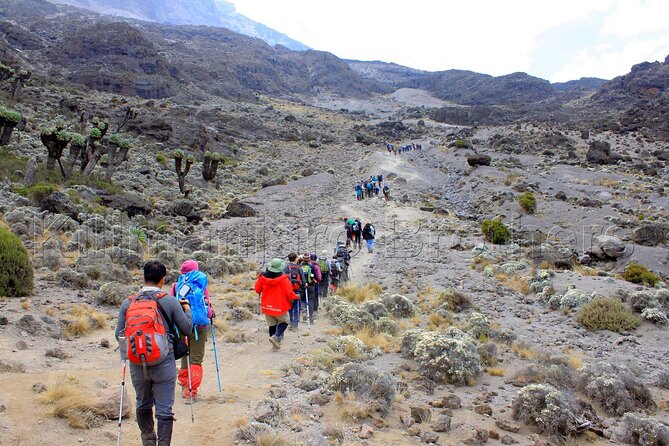
Day 4 is a short walk, and that’s the point. You’re adding extra time at Horombo Hut to help with acclimatization before the higher, more demanding stages.
You walk toward Mawenzi Hut area and pass Zebra Rocks, then return or continue as structured by your guide. The walk time is listed as 3 hours for this acclimatization portion.
Acclimatization days can feel like a detour when you’re excited to climb. But for Kilimanjaro, they often decide how you feel later. Slow, steady movement and time for your body to adjust is the difference between “I’m fine” and “I’m bargaining with myself at every step.”
You’ll also be eating meals provided at Horombo Hut for this day. Plan to keep your water intake consistent. The description explicitly recommends drinking enough water and walking slowly. That advice is simple for a reason.
Day 5: The Saddle and the Lunar Desert to Kibo Hut at 4,700 m
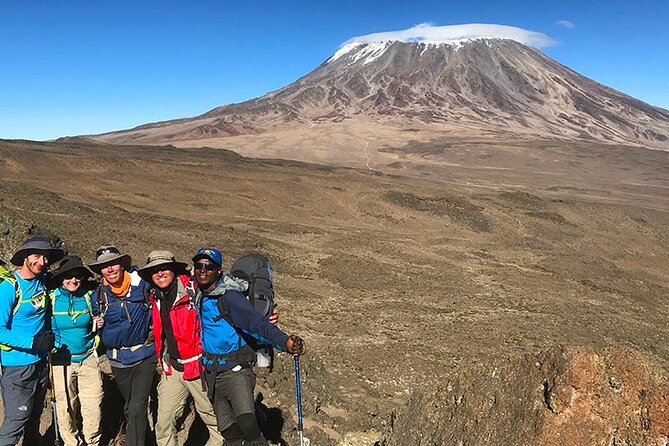
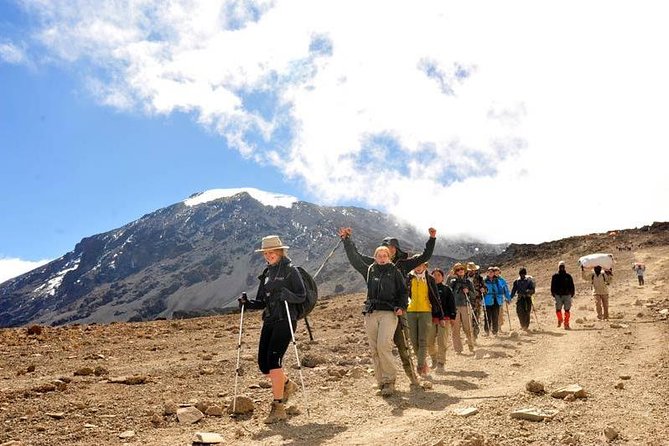
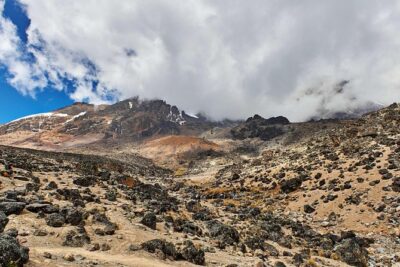
Day 5 is the big terrain shift. You climb very gradually toward the Saddle between Mawenzi and Kibo, described as the lunar desert. That description matters because it tells you what kind of day this is: fewer trees, more open sky, and a colder feeling as you gain elevation.
The walk time is listed as 6-7 hours, ending at Kibo Hut (4,700 m). You spend the night there in a comfortable hut, then take a low-key rest. The schedule calls for a very early night because the summit attempt is the next step.
Two details you should take seriously:
- No running water at Kibo Hut. Plan your hydration early and be prepared for limited facilities.
- The air at this altitude feels different at night. Even if you’re still warm during the day, you can get cold fast near freezing conditions.
This is also where your focus should tighten. Your final push depends on having enough energy for the summit night and having the mental calm to move slowly even when you want to go faster.
Day 6: Midnight Summit Push, Gillman’s Point, Sunrise at the Crater Rim, Uhuru Peak
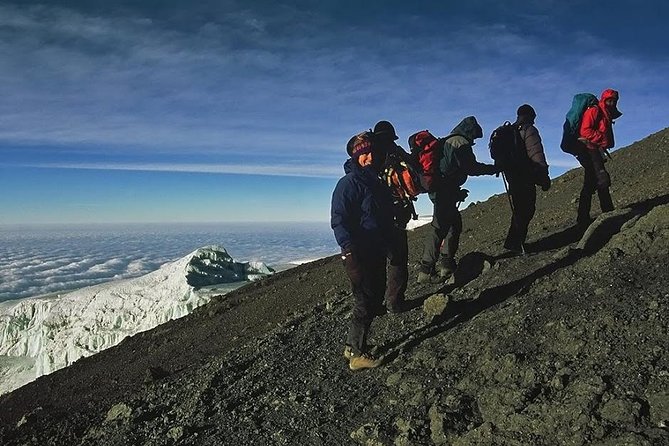
This is the classic Kilimanjaro story day. You wake up before midnight, start climbing in darkness, and move up through loose volcanic scree.
The ascent is described as steep, but with well-graded zig-zags, and you’re expected to take a slow but steady pace. Your guide pacing matters a lot here, because going too fast at the start is how people blow up.
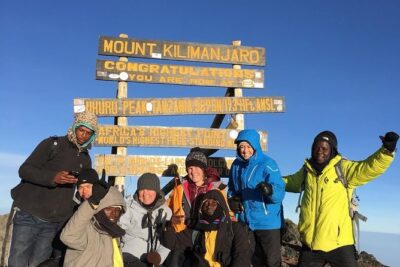
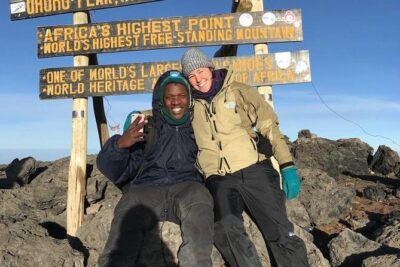
You climb to the rim of the main crater, known here as Gillman’s (5,685 m). You rest briefly to enjoy sunrise over Mawenzi. Then, if you still feel good, you continue to make the three-hour round trip along the crater rim to Uhuru Peak (5,895 m), the highest point in Africa.
After you take the time to appreciate what you did, you descend. The plan is a fast descent back to Kiko Hut (brief stop), then refresh at Kibo Hut, and continue down to Horombo Hut.
The walking time is listed as 13-15 hours for the summit day segment. That number is not a suggestion. It’s a real expectation. Even if you move well, you’ll likely spend much of the day climbing and descending in cold air and tired legs. Bring snacks you know you can eat when nauseous.
Day 7: Down Past Mandara Hut to Marangu Gate, Summit Certificate, and Dinner at the Resort
Day 7 is your descent day and also your emotional release. You walk down past Mandara Hut to Marangu National Park area. The listing notes that successful climbers receive their summit certificates. That’s a small paper moment that feels big because you earned it.
Then you’re transferred back to Kilimanjaro Mountain Resort for dinner and overnight. This is one of the best parts of the itinerary. After days of basic hut life and careful pacing, the resort dinner feels like a real meal, not just fuel.
The walk time from Horombo Hut to Marangu Gate is listed as 6-7 hours. Descents can be rough on knees, especially after a long summit day. A slow, careful rhythm saves you.
Day 8: Farewell in Moshi and Included Transfer to JRO
On Day 8, you say goodbye to your guide team, then take a private departure transfer included from Moshi to Kilimanjaro International Airport (JRO) for your flight.
If you want to squeeze in more, the operator says you can discuss options for a short safari or other add-ons. The key here is timing: summit day fatigue lingers, so don’t schedule anything too ambitious for the same day as your departure if you can avoid it.
What Makes This Marangu Plan Feel Practical, Not Just Romantic
I like how the route is built around three big ideas: pace, altitude, and recovery.
First, the days are structured with real walking blocks and set hut nights. That prevents the common Kilimanjaro problem of trying to “optimize” each day and arriving exhausted. Second, you get acclimatization time at Horombo before Kibo. That small extra effort tends to pay back in how you feel on the summit night. Third, the summit day plan includes breaks at meaningful points, like the crater rim for sunrise, and then a clear descent plan.
You also get clarity on what to expect physically:
- You’ll be walking around 2,700 m to 4,700 m before the summit.
- You’ll handle cold night climbing and loose scree.
- You’ll be descending for hours with a tired body.
And the logistics are mostly handled. Arrival transfer is included, so you’re not hunting for transport after a long travel day. Mobile ticketing is included too, which can simplify check-in.
The One Caution I’d Actually Plan For: Pickup Timing and Operator Consistency
One downside showed up in a negative experience that I think is worth taking seriously. A traveler named John reported the crew arriving about 30 minutes late to his hotel and not giving advance notice, forcing him to contact them. He also questioned whether the service matched the operator name. In the response from Africa Joy Tours, they apologized for the inconvenience and said they take recommendations seriously and expect that organizing tours can involve operational inconvenience.
What does that mean for you, in plain terms? Kilimanjaro success depends on calm coordination. If you’re the type who hates waiting in the dark, do this: confirm pickup details the day before, make sure your hotel contact is correct, and keep a way to message the driver or office quickly. It’s a small step that can save you stress.
Best Months to Climb Kilimanjaro and Why Weather Matters More Than You Think
The plan calls out timing for climbing:
- Avoid March, April, and May because of long rains.
- November usually has short rains and doesn’t rain every day, so climbing is possible.
- Best months are listed as January, February, August, and September.
- July can be colder, and November to December can be wet.
This matters because your summit night experience depends on visibility and conditions. Even when the route schedule stays the same, weather changes how cold it feels, how your footing is, and how readable the sunrise from the crater rim will be.
If you can travel in the January-February window, you’re likely chasing clearer conditions. If you’re going in a wetter period, pack for damp gear and assume slower moments.
Who This Trip Suits (and Who Should Rethink It)
This Marangu Route 6-day style trip suits you if:
- You want a well-defined hut itinerary with acclimatization built in.
- You prefer structured logistics like included transfers and scheduled briefing time.
- You can handle long walking days and cold summit-night temperatures.
You might rethink if:
- You dislike popular routes and want complete quiet on the mountain.
- You have issues with basic hut facilities, especially since Kibo Hut has no running water.
- You need flawless, zero-wait coordination, because operational timing can vary and you’ll want to be proactive about confirmation.
Should You Book This Kilimanjaro Marangu Route 6-Day Climb?
If your goal is a classic Kilimanjaro climb with a clear plan, hut nights, and a summit attempt that’s taken seriously, this is a solid option. The value is in what’s bundled, especially airport transfers, the pre-climb briefing, and the fact that park admissions are included during the hiking days.
But I’d book with open eyes. Confirm pickup timing ahead of time. If you care about smooth transfers, add an extra check-in the day before. And choose your month wisely to reduce weather stress.
If you do those two things, you’ll be set up for the best kind of Kilimanjaro day, the one where you can focus on slow steps, steady breathing, and that sunrise moment at the crater rim.
FAQ
Where does the Kilimanjaro Marangu climb start and end?
The itinerary starts and ends at Kilimanjaro Mountain Resort in Marangu. You arrive via private transfer from Kilimanjaro International Airport (JRO) and depart with an included private transfer from Moshi to JRO.
What is the meeting time for the tour?
The information provided lists a start time of 8:30 am. On Day 1, there is also an evening pre-climb briefing and equipment check at 5:30 pm.
What hiking days and elevations are included?
The climb runs through hut-to-hut stages including Marangu Gate to Mandara Hut (about 2,700 m), Mandara to Horombo Hut (about 3,720 m), acclimatization at Horombo, Horombo toward the Saddle to Kibo Hut (4,700 m), and the summit day from Kibo Hut to the crater rim (Gillman’s 5,685 m) and Uhuru Peak (5,895 m), then descent to Horombo. Day 7 continues down to Marangu Gate.
Are meals and tickets included?
The package includes admission tickets (park entry) for the hiking days. Day 1 includes dinner and breakfast. Later days include hut meals as described, including dinner and overnight at huts and meals provided at Horombo Hut for the acclimatization day.
Is this a private tour?
Yes. It is listed as a private tour/activity, with only your group participating.
Can I cancel, and what happens if weather prevents the climb?
You can cancel free of charge up to 24 hours in advance for a full refund. If the experience is canceled due to poor weather, you’ll be offered a different date or a full refund.
The Marangu Trail
- Kilimanjaro climb, Marangu route (6-day)
★ 5.0 · 72 reviews - Climbing Kilimanjaro – Marangu Route
★ 5.0 · 65 reviews - Best Kilimanjaro Adventures 6 Days Marangu Route Experience
★ 5.0 · 18 reviews - Kilimanjaro Private Climbing in 6 Days Marangu Route
★ 5.0 · 16 reviews - 6 Days Climb Kilimanjaro Through Marangu Route
★ 4.5 · 15 reviews
Kilimanjaro, Route by Route
- Kilimanjaro climb by Lemosho Route (7-day)
★ 5.0 · 651 reviews - Kilimanjaro climb, Machame Route (7-day)
★ 5.0 · 262 reviews - Kilimanjaro Climbing Lemosho Route 8 Days.
★ 5.0 · 186 reviews - Climbing Kilimanjaro – Machame Route
★ 5.0 · 170 reviews - Climbing Kilimanjaro through 7 days Machame Route
★ 5.0 · 151 reviews
Just added from around Moshi

Kilimanjaro Marangu Route, compared.
 ★ 5.0Kilimanjaro climb, Marangu route (6-day)From $2,90272 reviews
 ★ 5.0Climbing Kilimanjaro – Marangu RouteFrom $2,00465 reviews
 ★ 5.0Private Full Day Hiking Experience to Marangu RouteFrom $26061 reviews
 ★ 4.5From Arusha/Moshi: Kilimanjaro Hike Marangu Route Day TripFrom $10154 reviews
 ★ 5.0Mount Kilimanjaro Day Hike Through Marangu Route to Mandara HutFrom $26537 reviews
 ★ 5.0Kilimanjaro Climbing 5 days Marangu routeFrom $90022 reviews
 ★ 5.0Best Kilimanjaro Adventures 6 Days Marangu Route ExperienceFrom $1,00018 reviews
 ★ 5.0Kilimanjaro Private Climbing in 6 Days Marangu RouteFrom $2,00016 reviews
Browse the lists this tour appears in