
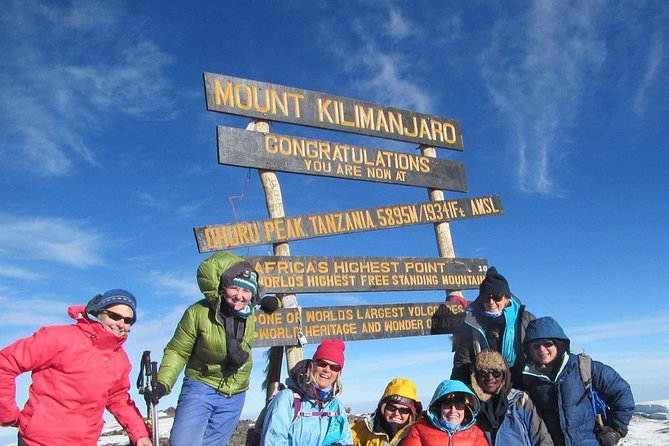
REVIEW · KILIMANJARO LEMOSHO ROUTE
Kilimanjaro Climb – 8 Days Lemosho Route
A long route, a kinder climb to the top. The 8-day Lemosho trek starts at Londorossi Gate near the Shira area and moves through rainforest, plateau scenery, and stark desert terrain before a summit bid. You also meet the Machame route connection around Lava Tower, then work your way through the Barranco Valley and up the Great Barranco Wall toward the glacier zone.
I like that this plan is built for acclimatization. You get a longer runway than shorter options, and the day-by-day structure keeps you moving but not rushing. I also like the human setup: you travel with professional mountain guides, plus cooks and porters, and you get a gear check and briefing with your head guide.
One thing to think about is that $2,900 is not a budget trek, and the price does not include travel insurance or tips. Also, this experience depends on good weather, so plan for possible date changes if conditions are bad.
In This Review
- Key things that make this Lemosho climb work
- Where the Lemosho route fits in a Kilimanjaro plan
- Moshi to Londorossi Gate: day 1 starts in the rainforest
- Shira Plateau days: moorland, moorland, more moorland (and views)
- From Shira Hut to Lava Tower: a key junction and the first real change
- Barranco Valley to Karanga Camp: learning to pace on day 5
- Karanga to Barafu: the alpine desert setup for summit night
- Summit day from Barafu: the 6 to 8 hour grind to the top
- Day 8 from Mweka Camp to Mweka Gate and back to Moshi
- The service level: guides, porters, cooks, and the safety net
- Price and value: what $2,900 actually buys you
- Who this 8-day Lemosho trek is best for
- Should you book the 8-day Lemosho route with Incredible Africa Adventures?
- FAQ
- How long is the Kilimanjaro climb on the Lemosho route?
- Where does the trek start?
- What are the main camps you visit during the 8 days?
- Is transport included from Moshi to the airport and back?
- Are meals and water included on the trek?
- What parts of the trip are included in the price?
- Are hotel meals included?
- Is this a private group or shared with other people?
- What happens if weather is poor?
Key things that make this Lemosho climb work
- Remote start from Londorossi Gate gives you that quieter, off-the-main-feeds feeling while still connecting well to the summit plan.
- More days for acclimatization is the big advantage of the Lemosho approach, built into the pacing across camps.
- Meet-up around Lava Tower lets the route gain momentum without giving up the earlier, scenic plateau time.
- Barranco Valley to the Great Barranco Wall is a memorable “work hard, recover smart” stretch on the way to the glacier zone.
- Summit day is serious, but structured with a long push up and then a long descent back down the mountain.
- Your money includes real mountain logistics like park entry, camping fees, and mountain meals with water, not just a guide.
Other ways up Kilimanjaro we reviewed
- Kilimanjaro climb by Lemosho Route (7-day)★ 5.0 · 651 reviews
- Kilimanjaro climb, Machame Route (7-day)★ 5.0 · 262 reviews
- Kilimanjaro Climbing Lemosho Route 8 Days.★ 5.0 · 186 reviews
- Climbing Kilimanjaro – Machame Route★ 5.0 · 170 reviews
Where the Lemosho route fits in a Kilimanjaro plan
The Kilimanjaro experience is equal parts planning, patience, and stamina. The Lemosho route is often picked when you want a more gradual path upward. This one is described as remote and less commonly used, which matters because it changes the whole feel of the trek. Instead of the constant crowds, you get wider spaces in the rain forest, more open plateau views, and more dramatic shifts in terrain.
The other reason people choose Lemosho is simple: time. This itinerary runs about 8 days, and the schedule leans into acclimatization. That does not guarantee a summit, but it helps you give your body a chance to adjust as you climb. If you’re coming from sea level, that extra patience can be the difference between grinding and coping.
Finally, the trip stays practical about how you get there. You’re based around Moshi. The included transport takes care of getting you to and from Kilimanjaro International Airport and into accommodation in Moshi, so you can focus on the mountain.
Moshi to Londorossi Gate: day 1 starts in the rainforest
Day 1 is designed to ease you into the climb. You go from Moshi to Londorossi Gate, then hike to Mti Mkubwa Camp in the rain forest zone. The trekking time is listed at about 3 hours over roughly 7 km, with around 360 m of altitude gain.
Here’s what that means for you on the ground. A shorter day at the beginning helps you get your bearings fast: moving time stays manageable, and you still get the full “you are actually going up Kilimanjaro” moment early. The rainforest setting also tends to feel less exposed than higher zones, so it can be a steadier start emotionally, not just physically.
Also note the structure of the service. Your head guide handles a briefing and a gear check and arranges equipment hire if you need it. That setup is valuable early because it reduces the chance of small problems snowballing later.
Shira Plateau days: moorland, moorland, more moorland (and views)
Days 2 and 3 are where the Lemosho route earns its reputation for scenic trekking. On day 2 you trek from Mti Mkubwa Camp to Shira I Camp. The route is about 6 to 7 hours, around 10 km, with about 755 m of altitude gain. Day 3 continues from Shira I Camp to Shira Hut at roughly 3 to 4 hours for 8 km, with about 305 m of gain. Both days are listed in moorland.
This plateau time is more than a scenic interlude. The Shira Plateau portion is described as a geologic story, formed where an earlier volcano erupted and later shaped by the Kibo eruption filling and expanding the region. You don’t need geology homework to enjoy it, but it gives context for why the terrain looks the way it does: wide, open, and oddly dramatic even when conditions are cloudy.
For practical value, these moorland stages help you acclimatize because you are still climbing, but the days are not brutal. You’re also giving your body time to adjust before you step into the colder, drier, more demanding zones that come later.
Lemosho itineraries worth reading next
From Shira Hut to Lava Tower: a key junction and the first real change
Day 4 is where your route begins to tighten into the classic Kilimanjaro summit workflow. You trek from Shira Hut to Lava Tower and then onward to Barranco Camp. The trek is listed at 6 to 7 hours and about 10 km, with only about 50 m of altitude gain.
At first glance, 50 m gain might look easy. The key is in what happens during the day: you go from Shira area into semi-desert terrain, and you reach Lava Tower where you meet up with the Machame route connection. That meeting matters because it signals that your itinerary is now aligning with the broader summit path.
Then you descend into the Barranco Valley and set up the next day’s ascent rhythm. Even if the altitude gain looks low, this is still a day that can challenge your legs, since valley terrain often means uneven footwork, not just number of meters.
Barranco Valley to Karanga Camp: learning to pace on day 5
Day 5 takes you from Barranco Camp to Karanga Camp. It is listed at 3 to 4 hours over about 6 km, with around 140 m of altitude gain. The environment is described as alpine desert.
This is a good day to pay attention to pacing. Alpine desert terrain tends to feel harsher and drier, even if you don’t have exact temperature numbers. The benefit of this day is that it pushes you forward while keeping the duration reasonable. It also follows the Barranco work from the day before, so you’re building stamina while still getting time to acclimatize.
Think of day 5 as “keep it steady.” The biggest risk on mountain treks is treating every day like the same effort. This day is short enough that a strong hiker could overdo it. Keep your effort controlled. You want to arrive in good shape for the next stage, not tired and depleted.
Karanga to Barafu: the alpine desert setup for summit night
Day 6 is the bridge day into summit positioning. You hike from Karanga Camp to Barafu Camp in alpine desert. The trek is listed at about 2 to 4 hours, with roughly 4 km and about 600 m altitude gain.
This is the day that can surprise you. It is shorter in distance, but the altitude gain number is significant. That combo can feel steeper than you expect. If you tend to go by time only, use the altitude gain as a cue. You want your breathing to stay calm. A moderate, even pace tends to work best as you move toward the Barafu area.
In a practical sense, Barafu Camp is your summit pre-stage, so day 6 is about preparation, not heroics. You are building the body readiness that the summit push depends on.
Summit day from Barafu: the 6 to 8 hour grind to the top
Day 7 is the summit bid. You go from Barafu Camp to the summit over about 6 to 8 hours, covering around 7 km with about 1296 m of altitude gain. The terrain is listed under glaciers.
After that, the day continues with the descent. The data lists a descent time of another 6 to 8 hours, covering about 12 km with about 2896 m of altitude loss.
So yes, this is the long day. It is not just a climb up and then a scenic stroll down. The mountain asks for sustained effort, and the descent is hard in its own way. Your quads and knees take a beating on steep terrain, and fatigue can turn your form sloppy. This is where the earlier acclimatization time pays off, because you are more likely to have the energy to keep moving once you start feeling the altitude and the cold.
One more practical note: this plan includes mountain meals and water while you’re on the trek. That matters most on summit day because staying fueled and hydrated is part of the safety equation. The itinerary is structured to keep your basic needs covered, so you are not juggling extra logistics mid-day.
Day 8 from Mweka Camp to Mweka Gate and back to Moshi
Day 8 shifts from altitude recovery to finishing strong. You trek from Mweka Camp to Mweka Gate and back toward Moshi, listed at 4 to 5 hours, about 10 km, and about 1360 m of altitude loss. The environment is described as rain forest again.
This is a welcome emotional turn. After glacier-zone effort and a summit day, being back in rainforest terrain helps reset your senses. You still have to finish the walk, but the mood often changes because the climb phase is done.
You’re also not left hanging at the gate. The experience summary notes that upon arrival at Kilimanjaro International Airport, you’ll be met and transferred for an overnight stay at your hotel. That kind of wrap-up is underrated. It means you’re not immediately stuck figuring out transport when you’re tired.
The service level: guides, porters, cooks, and the safety net
This itinerary is sold as private, with only your group participating. That tends to matter for comfort and flow. You’re not squeezed into a larger shared schedule with mismatched walking speeds.
The crew structure is clear too. You get professional mountain guides, plus cooks and porters. You also get an emergency first-aid kit with facilities to help keep you safe. That does not remove risk on a mountain like Kilimanjaro, but it does show the operator is thinking about real-world safety systems, not just paperwork.
Then there is the “small but important” admin layer. You get park entry fees and camping fees included. You get mountain accommodation equipment included while on the route. And you’ll receive a mobile ticket.
Those details matter because they remove friction. When your costs and logistics are bundled, you spend less time checking what is included and more time focusing on your climb.
Price and value: what $2,900 actually buys you
At $2,900 per person for an 8-day Kilimanjaro climb, this is not a low-cost trek. But it may still be good value because several big items are included.
Included items worth your attention:
- Transport from and to Kilimanjaro Airport and accommodation in Moshi
- Park entry and camping fees
- Mountain accommodation equipment
- Professional guides, cooks, and porters
- 3 meals daily and water while on the mountain
- An emergency first-aid kit with facilities
Not included items that you must budget for:
- Hotel meals on non-trek days
- Travel insurance
- Personal items and tips for guides, porters, and cook
So how do you judge value? You compare the included mountain operations to what you would have to source yourself. Here, the trekking route costs, camping base logistics, and food support are all handled. That is a major part of what makes a Kilimanjaro climb expensive in the first place.
If you already have travel insurance and a plan for tips, this bundle can look more reasonable. If not, the total “real cost” will climb once you add those missing pieces.
Who this 8-day Lemosho trek is best for
This is best for you if:
- You want a longer acclimatization-friendly approach rather than a fast push
- You like a route with varied terrain, from rain forest through moorland and desert zones
- You prefer a private tour with only your group
- You want a clear support structure, including a head guide briefing and gear check
It may be less ideal if:
- You want the shortest possible time on the mountain
- You are relying on the operator to cover all costs, because travel insurance, tips, and hotel meals are not included
- You struggle with the idea that this depends on good weather, since it can be rescheduled or refunded under poor conditions
Also, the tour says you should have moderate physical fitness. That fits many first-time high-altitude hikers, as long as you respect the pacing and take acclimatization seriously.
Should you book the 8-day Lemosho route with Incredible Africa Adventures?
I’d book this if you want a steady climb plan with real mountain logistics handled, and you care about acclimatization. The Lemosho route’s structure, plus the way the itinerary connects through Lava Tower and then works through Barranco and the alpine desert stages, is built to keep you moving with a purpose.
Before you commit, do three things:
- Confirm you have travel insurance. It is not included here.
- Budget for tips and any personal items you will need.
- Mentally plan for weather variability, since the experience requires good weather and can change dates if conditions are poor.
If that fits your style, this is a strong, practical way to go after Kilimanjaro with support, structure, and a route that takes its time.
FAQ
How long is the Kilimanjaro climb on the Lemosho route?
The trip runs for 8 days approximately.
Where does the trek start?
It starts at Londorossi Gate, below the Shira Plateau, with day 1 leading to Mti Mkubwa Camp.
What are the main camps you visit during the 8 days?
You sleep at Mti Mkubwa Camp, Shira I Camp, Shira Hut, Barranco Camp, Karanga Camp, Barafu Camp, and then Mweka Camp.
Is transport included from Moshi to the airport and back?
Yes. The experience includes transport from and to Kilimanjaro Airport and your accommodation in Moshi.
Are meals and water included on the trek?
Yes. The package includes 3 meals daily and water while you are on the mountain.
What parts of the trip are included in the price?
Included items are transport to and from the airport, park entry fees and camping fees, mountain accommodation equipment, professional guides, cook and porters, mountain meals and water, fair treatment of the crew, and an emergency first-aid kit with facilities.
Are hotel meals included?
No. All meals at your hotel are not included.
Is this a private group or shared with other people?
This is a private tour/activity. Only your group will participate.
What happens if weather is poor?
The experience requires good weather. If it is canceled due to poor weather, you will be offered a different date or a full refund.
Lemosho, Compared
- Kilimanjaro climb by Lemosho Route (7-day)
★ 5.0 · 651 reviews - Kilimanjaro Climbing Lemosho Route 8 Days.
★ 5.0 · 186 reviews - Kilimanjaro climb, Lemosho Route (8-day)
★ 5.0 · 148 reviews - Kilimanjaro climb, Lemosho Route (6-day)
★ 5.0 · 129 reviews - Kilimanjaro Lemosho Route
★ 5.0 · 71 reviews
Kilimanjaro, Route by Route
- Kilimanjaro climb by Lemosho Route (7-day)
★ 5.0 · 651 reviews - Kilimanjaro climb, Machame Route (7-day)
★ 5.0 · 262 reviews - Kilimanjaro Climbing Lemosho Route 8 Days.
★ 5.0 · 186 reviews - Climbing Kilimanjaro – Machame Route
★ 5.0 · 170 reviews - Climbing Kilimanjaro through 7 days Machame Route
★ 5.0 · 151 reviews
Just added from around Moshi
Kilimanjaro Lemosho Route, compared.
 ★ 5.0Kilimanjaro climb by Lemosho Route (7-day)From $3,476651 reviews
 ★ 5.08-Day Small-group Lemosho Kilimanjaro Summit TrekkingFrom $2,895186 reviews
 ★ 5.0Kilimanjaro Climbing Lemosho Route 8 Days.From $2,300186 reviews
 ★ 5.0Kilimanjaro climb, Lemosho Route (8-day)From $3,975148 reviews
 ★ 5.0Kilimanjaro climb, Lemosho Route (6-day)From $3,034129 reviews
 ★ 5.0Kilimanjaro Lemosho RouteFrom $2,89071 reviews
 ★ 5.0Private Kilimanjaro Hike 7 Day Lemosho RouteFrom $2,45060 reviews
 ★ 5.0Climbing Kilimanjaro through 8 days Lemosho RouteFrom $2,76052 reviews
Browse the lists this tour appears in