
REVIEW · KILIMANJARO MARANGU ROUTE
Climb Kilimanjaro via Marangu Route 6 Days
Kilimanjaro is a long climb with real payoff. This 6-day Marangu route starts at Marangu Gate, moves from rainforest into moorland and alpine desert, and gets you to Uhuru Peak with a built-in acclimatization day. I like that the plan is structured and doable for people with solid fitness, not just hype. I also like the way the trip takes care of the basics for you, with meals, tents, mats, and fees included, so you can focus on pacing and staying safe. One thing to consider: the route can feel busy, and you may lose some of that quiet, empty-mountain feeling.
The day-by-day rhythm also matters, and this itinerary is clearly designed around altitude. You’ll spend time at Horombo to adjust, then you’ll make the steep push toward Kibo Huts before the big summit night. My only drawback is that the “hard days” are still hard, especially Day 4 and the early start on Day 5, so you can’t treat this like a casual hike.
In This Review
- Key things I’d plan around before you go
- Marangu Route from Moshi to Uhuru Peak, without the guesswork
- Day 1: Rainforest start at Marangu Gate and the wet-foot reality
- Day 2: Moorland opens, Mawenzi shows up, and altitude gets personal
- Day 3: The acclimatization day at Horombo, with two smart options
- Day 4: Steep terrain to Kibo Huts, and cold-weather planning for the summit night
- Day 5: Uhuru Peak push, then a fast downhill recovery
- Day 6: Rainforest descent to Marangu Gate, then Moshi/Arusha life resumes
- Caught between tents, huts, and meals: what you can expect on the mountain
- Price and value: is $1,800 fair for this kind of climb?
- How to handle crowds on a busy route day
- Who this Marangu 6-day trek is best for
- A realistic approach to altitude, weather, and gear
- Should you book this Kilimanjaro via Marangu 6-day climb?
- FAQ
- How many days is the Kilimanjaro climb?
- Where does the climb start?
- What is the highest point you aim for?
- What kind of accommodation is provided on the mountain?
- Are meals included?
- Does the tour include pickup and WiFi?
- Which day is the summit day?
- Is a portable flush toilet included?
- Is a doctor included with the group?
- What is the cancellation policy?
Key things I’d plan around before you go
- Marangu Gate start: You check in at the park entrance, then transition fast from lush rainforest to higher country.
- Acclimatization at Horombo: Day 3 is a true buffer, with optional walks if you feel good.
- Hut-camp style experience: The route centers on Horombo Huts and Kibo Huts, which changes the feel compared with tent-only camping.
- Cold-weather prep is real: Day 4 includes organizing warm gear, and you’re advised to keep water in a thermos.
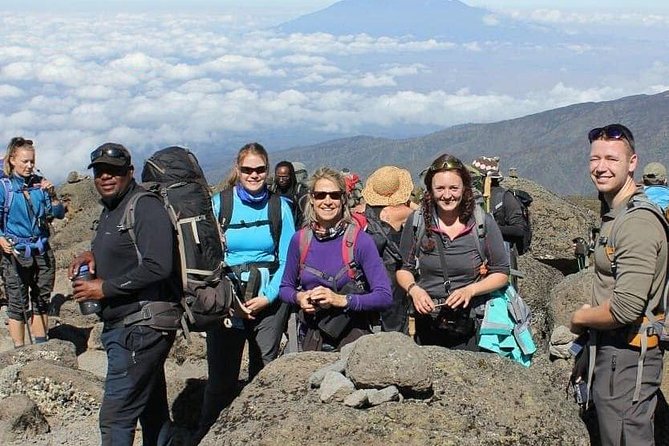
- Team support gets praised: Guides like Seleman Honguo and Allen Katunzi, plus chef Joachim, show up in the best feedback.
- Optional toilet costs extra: A portable flush toilet is not included and is listed at US$150 per toilet plus toilet tent.
Other ways up Kilimanjaro we reviewed
- Kilimanjaro climb by Lemosho Route (7-day)★ 5.0 · 651 reviews
- Kilimanjaro climb, Machame Route (7-day)★ 5.0 · 262 reviews
- Kilimanjaro Climbing Lemosho Route 8 Days.★ 5.0 · 186 reviews
- Climbing Kilimanjaro – Machame Route★ 5.0 · 170 reviews
Marangu Route from Moshi to Uhuru Peak, without the guesswork
This Kilimanjaro climb is based out of Moshi and uses the Marangu Gate entry. The “feel” of the route comes down to how the mountain changes under your feet. Day 1 starts in forest, where it can be wet and muddy at lower altitude. As you rise, the vegetation opens up into moorland, then dries into alpine desert near the summit zone.
What I like about this setup is the balance between effort and timing. You hike several hours each day, but you also get altitude help built into the schedule, especially on Day 3 at Horombo Huts. That matters because altitude sickness often shows up when your body is playing catch-up.
The other big advantage is that you’re not managing everything. You get meals for multiple days (5 breakfasts, 5 lunches, 5 dinners), plus 3-season mountain tents and double layered sleeping mats. Add in all fees and taxes, and the trip is designed to be plug-and-play. You still control your pacing, but the logistics are handled.
Day 1: Rainforest start at Marangu Gate and the wet-foot reality
You’ll leave Moshi after breakfast and drive to Kilimanjaro National Park’s Marangu Gate. Once you arrive, you check in and register, which kicks off your climb in a straightforward, official way. Then the walking begins through woods and rainforest.
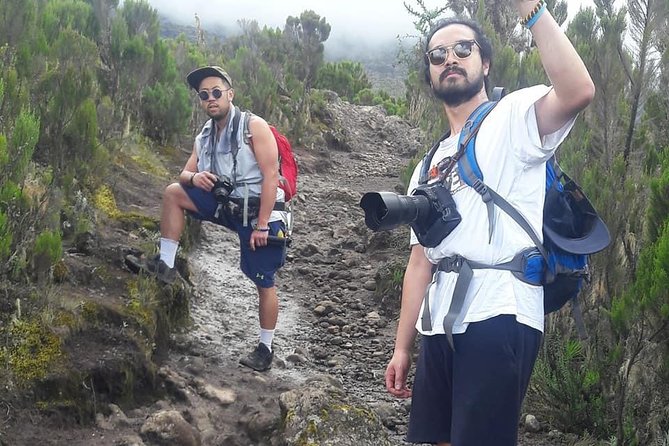
This first leg is listed at 5 to 7 hours, with an overnight altitude around 8,858. The habitat here is rainforest, which is exactly why your footwear matters. At lower altitude the route can be wet and muddy, so you want shoes that handle slippery ground and socks that don’t stay damp forever.
Wildlife is possible on this stretch. You might spot Colobus monkeys (black or white fur), and you’ll also be watching for different bird species. Don’t plan on it like a guarantee, but it’s one of those “if you’re paying attention, you’ll notice” parts of the mountain.
Where Day 1 can frustrate people is pacing. If you sprint early just to prove you can, it can backfire later when the altitude starts climbing. Think steady. Use the rainforest day to warm up your legs and your breathing rhythm.
Day 2: Moorland opens, Mawenzi shows up, and altitude gets personal
Day 2 shifts from the end of woodland into moorland. This is where the view work starts, because the terrain opens and you can see the jagged peaks of Mawenzi rising toward the sky.
The hike is again 5 to 7 hours, and you overnight around 12,205 at Horombo Huts. The habitat changes to heath and moorland. This is also when people commonly start noticing early altitude symptoms. That’s not something to ignore or “walk through.”
The practical move is to communicate early with your guide at the first signs of illness. Tell them fast, and do not try to tough it out alone. A small change in how you feel can become a bigger problem if you keep pushing.
When you reach Horombo Huts, you’ll have time to unpack and then enjoy the view of Kibo before dinner. That moment is part of the reward. You’re higher now, and you can finally see the big target you’ll be aiming for in the next couple of days.
Marangu, other operators and other lengths
Day 3: The acclimatization day at Horombo, with two smart options
Day 3 is an extra day at Horombo Huts, and that’s a big deal. The schedule here is built for acclimatization, meaning your body gets time to adjust before the steep route to Kibo Huts.
If you feel any symptoms or you’re wiped out, you’re expected to stay at camp and rest. That’s not “optional” on a safety level. This is the day you protect the summit attempt.
If you’re feeling well-acclimated, the itinerary gives you two options:
- A short walk up toward Mawenzi Hut to admire the views of Kibo and Mawenzi.
- A trip to Zebra Rocks, which includes a climb of about 310 meters, with a reminder that this still counts as effort at altitude.
The hike time for this day is listed as 1 to 2 hours. The point is not distance. The point is giving your body mild work while letting your overall plan breathe.
If you’re the kind of person who likes to move, this is the day you can scratch that itch without detonating your legs for the next push. If you’re not feeling great, this is still a win, because resting well is also training.
Day 4: Steep terrain to Kibo Huts, and cold-weather planning for the summit night
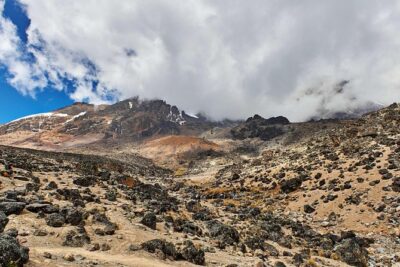
Day 4 is where the mountain turns harder. You continue across heath that shifts into highlands between Mawenzi and Kibo. The ground is described as dotted with large and small volcanic rocks, which is a good clue that the surface may not be soft. Expect your footing to matter.
The climb to Kibo Huts is listed at 5 to 7 hours, and the overnight altitude jumps to around 15,430. The habitat is alpine desert. This is the setting where people often feel the cold most strongly, because the air gets thinner and your body is working without the same warmth of lower elevation days.
Once you arrive at Kibo Huts, you organize equipment and warm clothes for the summit night. The itinerary specifically advises using a thermos for water so it stays drinkable and you can avoid freezing conditions.
Here’s the practical takeaway: your summit success depends as much on gear habits as on stamina. Keep things ready so you’re not scrambling while you’re tired. Get to bed early because the next day’s trek requires sleep worth of energy.
Day 5: Uhuru Peak push, then a fast downhill recovery
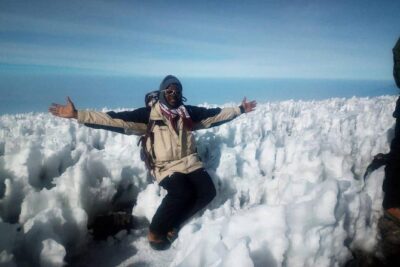
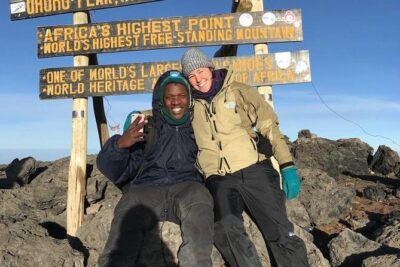
Day 5 is the summit day and it starts in the cold, dark, and early. Depending on conditions, you may see snow on the final stretch to Uhuru Peak, the highest point in Africa.
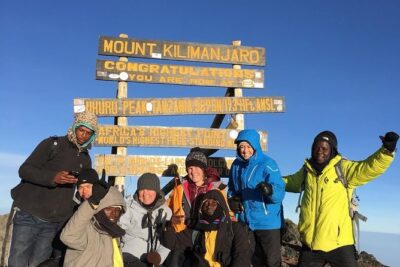
As you reach the peak, the altitude is listed as 5,895 meters. That number is the headline, but the bigger story is the experience of getting there while your breathing is working hard. You’ll take a photo in front of the Uhuru Peak sign, then start heading back.
The descent back to Kibo Huts is listed at 4 to 5 hours, and you’ll stop at Kibo Huts for lunch. After lunch, you move on to Horombo Huts for a full night’s rest.
This is also the day where people often feel a strange mix of relief and fatigue. You’ve done the big climb, but you’re still at altitude and your body has been burning energy for hours. The descent is easier than the ascent, but it’s still long, and it’s not a day to force extra speed.
Day 6: Rainforest descent to Marangu Gate, then Moshi/Arusha life resumes
On the final day, you do the descent through rainforest back to Marangu Gate. The itinerary lists 5 to 7 hours of hiking, plus lunch and a farewell with the mountain crew.
After leaving the park, you drive back for shower time and a commemorative dinner. The plan mentions Arusha for the post-climb return, so it’s a good idea to assume you’ll be heading there rather than straight back to Moshi.
The practical value of Day 6 is simple: it’s your recovery day. Your legs will be tired, your feet may be sore, and the goal is to end safely, not to sprint for completion bragging rights.
Caught between tents, huts, and meals: what you can expect on the mountain
This itinerary mixes camp living with defined stopovers at Horombo Huts and Kibo Huts. At the same time, the included gear list highlights 3-season mountain tents and double layered sleeping mats. What that means for you in real terms is that you should plan for a camp setup where shelter and warmth are your responsibility to use correctly.
The sleeping system is provided, which is a huge value point. Many people underestimate how much a good sleeping mat reduces fatigue at altitude. You’ll also get multiple meals throughout the trek:
- Dinner (5)
- Breakfast (5)
- Lunch (5)
And yes, food quality matters on summit attempts. In the feedback tied to this provider, chef Joachim gets called out for delicious food. I can’t promise your chef will be the same person, but it’s a useful hint that food is not treated as filler.
Two things to know so you’re not caught off guard:
- A portable flush toilet is listed as extra, at US$150 per toilet plus toilet tent.
- A doctor for the group is not included, so you should not assume medical staffing is part of the package.
Price and value: is $1,800 fair for this kind of climb?
At $1,800 per person, this is not a budget activity. But it’s also not just someone leading you with a handheld compass. The inclusions are meaningful:
- All fees and taxes (including 18% VAT on tour fees and services)
- Mountain crew pay aligned with Kilimanjaro National Park Authority guidelines
- Tents and sleeping mats
- Meals for the trek days
- Pickup offered
- WiFi on board
- Mobile ticket
For many hikers, the biggest value is the crew and the systems around it. Kilimanjaro is complex. You benefit from trained support, especially on acclimatization days when your body sends signals you might not recognize at first.
You also get a private experience, since it’s listed as private and only your group participates. That can be a real comfort factor when you want quiet time, consistent pacing, and easier communication with your guide.
One more value detail: at least one feedback story mentions flexibility, where the team helped a solo climber finish in 4 days when they wanted to go faster. That doesn’t mean every trip can compress the schedule safely, but it suggests the provider pays attention to how hikers are doing, not just the calendar.
How to handle crowds on a busy route day
Even when you’re excited, Kilimanjaro’s popularity shows up on your schedule. The route described here can have heavy crowds, and that can reduce some of the magic you’d expect from a big wild mountain.
You can’t eliminate crowds. But you can control your experience inside them:
- Start your day calm and early, and follow your guide’s pace cues.
- When you stop for photos, keep it efficient. Move quickly back to breathing and water.
- Treat the crowd as a pacing reference, not a pressure source.
The mountain is still the mountain. But your mindset changes how much the busyness affects you.
Who this Marangu 6-day trek is best for
This climb is for people with strong physical fitness. It’s also better suited to hikers who can handle steep walking and multiple days at altitude.
If you like the idea of sleeping and stopping in a structured way, with hut-camp style segments at Horombo and Kibo, this plan fits well. If you want a gentler hike with minimal altitude intensity, this may not match your expectation. Day 4’s steep final push to Kibo Huts and the summit night effort are the proof points.
Where it makes sense:
- You have hiking experience or you’re confident in multi-hour climbs.
- You value safety through pacing and acclimatization, not through denial.
- You want a private group experience and a provider that’s known for friendly, professional teamwork.
A realistic approach to altitude, weather, and gear
Kilimanjaro is a high-altitude trek. Even when your fitness is strong, your body still has to adjust.
Follow the schedule as designed, especially the acclimatization day at Horombo. If you feel sick, take the rest your itinerary allows. Pushing harder on the wrong day is how summit attempts fail.
For weather, the itinerary implies cold and possibly snow on the summit stretch. That means you should pack warm clothes for summit conditions and treat water handling as part of your cold-weather plan. The thermos advice is there for a reason.
Also keep your feet in mind on Day 1. Wet, muddy rainforest ground can turn a good trip into a blister story fast. Good footwear and sock management matter more than you think.
Should you book this Kilimanjaro via Marangu 6-day climb?
I’d book this if you want a structured 6-day Kilimanjaro climb, with a real acclimatization window, clear hut-camp timing, and included support like tents, mats, and full meal service. The price is not cheap, but when you look at what’s covered, it’s easier to justify for most hikers who don’t want to assemble the logistics themselves.
I would hesitate if you are sensitive to crowds, or if you’re expecting a gentle walk with minimal steep effort. Day 4 and the summit day require serious stamina and smart pacing.
If you book, go in with the right mindset: slow and steady, listen to your body, and use the acclimatization day like it’s sacred. That’s the difference between a satisfying summit story and a stressful ending.
FAQ
How many days is the Kilimanjaro climb?
The tour is listed as 6 days approximately, with several hiking days and one extra acclimatization day at Horombo Huts.
Where does the climb start?
You leave Moshi and head to Kilimanjaro National Park’s southeast entrance, Marangu Gate, where you check in and register before beginning your ascent.
What is the highest point you aim for?
You aim for Uhuru Peak, the highest point in Africa. The altitude listed at the peak is 5,895 meters.
What kind of accommodation is provided on the mountain?
The inclusions list 3-season mountain tents and double layered sleeping mats. The route includes stops at Horombo Huts and Kibo Huts.
Are meals included?
Yes. The tour includes 5 breakfasts, 5 lunches, and 5 dinners.
Does the tour include pickup and WiFi?
Pickup is offered, and WiFi is listed as included on board.
Which day is the summit day?
The summit push to Uhuru Peak happens on Day 5.
Is a portable flush toilet included?
No. A portable flush toilet with a toilet tent is listed as extra, at US$150 per toilet plus toilet tent.
Is a doctor included with the group?
No. A doctor for the group is listed as not included.
What is the cancellation policy?
The tour offers free cancellation. You can cancel up to 24 hours in advance for a full refund, with the cut-off based on local time.
The Marangu Trail
- Kilimanjaro climb, Marangu route (6-day)
★ 5.0 · 72 reviews - Climbing Kilimanjaro – Marangu Route
★ 5.0 · 65 reviews - Best Kilimanjaro Adventures 6 Days Marangu Route Experience
★ 5.0 · 18 reviews - Kilimanjaro Private Climbing in 6 Days Marangu Route
★ 5.0 · 16 reviews - 6 Days Climb Kilimanjaro Through Marangu Route
★ 4.5 · 15 reviews
Kilimanjaro, Route by Route
- Kilimanjaro climb by Lemosho Route (7-day)
★ 5.0 · 651 reviews - Kilimanjaro climb, Machame Route (7-day)
★ 5.0 · 262 reviews - Kilimanjaro Climbing Lemosho Route 8 Days.
★ 5.0 · 186 reviews - Climbing Kilimanjaro – Machame Route
★ 5.0 · 170 reviews - Climbing Kilimanjaro through 7 days Machame Route
★ 5.0 · 151 reviews
Just added from around Moshi
Kilimanjaro Marangu Route, compared.
 ★ 5.0Kilimanjaro climb, Marangu route (6-day)From $2,90272 reviews
 ★ 5.0Climbing Kilimanjaro – Marangu RouteFrom $2,00465 reviews
 ★ 5.0Private Full Day Hiking Experience to Marangu RouteFrom $26061 reviews
 ★ 4.5From Arusha/Moshi: Kilimanjaro Hike Marangu Route Day TripFrom $10154 reviews
 ★ 5.0Mount Kilimanjaro Day Hike Through Marangu Route to Mandara HutFrom $26537 reviews
 ★ 5.0Kilimanjaro Climbing 5 days Marangu routeFrom $90022 reviews
 ★ 5.0Best Kilimanjaro Adventures 6 Days Marangu Route ExperienceFrom $1,00018 reviews
 ★ 5.0Kilimanjaro Private Climbing in 6 Days Marangu RouteFrom $2,00016 reviews
Browse the lists this tour appears in